Showing posts with label review. Show all posts

Sunday, January 26, 2014

Rotation


First, identify what counterclockwise means.  The way to remember is that counter means against.

Next, identify the points.  U is at (2,-2), A is at (3, -2), G is at (1, -5), then N is at (2, -5). The next part is a bit tricky and uses your knowledge about the quadrants.  So to go 90 degrees, I need to switch X and Y. and then because I went from Quadrant IV to Quadrant I, I turn all the negatives into positives. To go 180 degrees, I need to go from Quadrant IV to Quadrant II, so I need to switch their signs.  To go 270 degrees, I need to switch their signs and then switch X and Y.

In this case, I only want to go 90 degrees, so lets switch X and Y and turn them all positive.  U becomes U' (2,2).  A becomes A' (2, 3).  N becomes N' (5, 2).  Finally G becomes G' at (5, 1)


All that's left is to draw in the lines.

Friday, January 24, 2014

Translations

First identify the points of the shape.  2 of them are in quadrant 1 and 1 is in quadrant 4.  So D is at 1 left and 3 up.  So D (1, 3) is the top of the triangle.  Then U is 4 left 0 up, so U (4, 0).  Then C is 0 left and 2 down: C (0, -2).
Next, subtract 5 from the x and add 2 to the y.  So D' (1 - 5, 3 + 2)  or (-4, 5).  U' would be (4 - 5, 0 + 2) or (-1, 2).  C' would be (0 -5, -2 + 2) or (-5, 0).


Once the new points are plotted, draw the lines in of the shape.

Geometry Basics

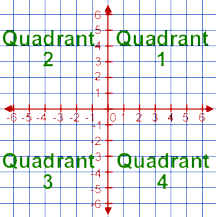
Coordinate Plane

Two number lines set at 90 degrees from each other create a coordinate plane.


http://www.math.com/school/subject2/images/S2U4L1DP.gif


x-axis

The x-axis is the number line going left to right.  Positive numbers are on the right, and negative numbers are on the left.

y-axis

The y-axis is the number line going up and down.  Positive numbers are on the top, and negative numbers are on the bottom.

point

A point is a specific spot on the graph.

origin

The point where the x-axis and y-axis intersect.  It's ordered pair is (0,0).

ordered pair

The distance from the origin showing first to the left or right (x) then up or down (y).  The point (4,2) is right 4, up 2.


Line

A line is when two or more points are in a row.  Most people can draw a line based on two points, but in order to find other points on the line without using the graph, you need to understand the formula, which is y = mx + b.  Y is the dependent variable, X is the independent variable.  This means that all the X will have one and only one Y.  The other two letters help define the line.  b is called the y-intercept and shifts the graph up or down by that number.  m is called the slope and defines how fast the graph goes up.

Slope

To find the slope, you get two points.  Then you find the difference between the first and second in height, then the difference between the first and second in distance left or right from 0.


On this graph here, you can identify the following points: (-2, 1 ) (-1, 2) (0, 3) (1, 4) (2, 5)

To find the slope identify the distance between Y, then divide it by the distance between X.  So for (-2, 1) to (-1, 2), the distance between 1 and 2 is 1.  Then we divide it by the distance between -2 and -1 and we get 1.  1 divided by 1 is 1, so m = 1.  Then we identify where the line is when X is zero.  (0, 3).  So b = 3.  The line is y = 1x + 3.

Sunday, October 27, 2013

Pythagorean Triplets

Here are some more examples of Pythagorean Theorem problems.


Video Link

Linear Patterns

Here's a video explaining how to find a pattern based on a sequence.


Video Link

Most of you are fairly accomplished at this method.  What you have been having trouble at is understanding how to write the rule.  Mr. Khan shows a way to understand the rule in this video.


Video Link

Here's a more complicated example that actually gets Mr. Khan going into Algebra 1!


Video Link

Here's one more example.


Video Link

Hope these help you prepare.

Tuesday, October 22, 2013

Tuesday, October 15, 2013

Sunday, September 15, 2013

Radicals

Radicals are the inverse operation of exponents.  The most common one is the square root, which asks you to find what number multiplies by itself in order to get the number under the radical.  Sometimes there won't be a clear answer, and in that case you will have to factor the number down into numbers that are squares and numbers that aren't.  Then you can pull the ones that are out by taking their square root and leave the numbers that aren't inside.

Here's a video explanation.


Part 2: Examples


Part 3: Estimating the value of a square root.


Saturday, September 14, 2013

Estimating Area

Here's one way to estimate area.


You will probably be given a problem similar to this on the STAAR.  The reason why things like this are useful is for arts and crafts projects where part of an object has something done to it, like part of it is painted and the rest is not, or part of it has glitter on it, etc.

The estimated area tells us something about how much of a cover we need to get, so how many bottles of glittter or buckets of paint would be needed.  This way we don't have to make extra trips to the store either to buy more or to return what we had that was too much.

This is not the only example of the use of this concept, but is one of the most clear.  Other examples include washing windows on a building that isn't completely covered with them, figuring out how much floor wax to use when buffing a wood or tile floor, figuring out how much grass a sprinkler head would cover.  I bet you can think of some others.

Order of Operations

Mr. Khan from Khan Academy explains why we need order of operations, and then links that to PEMDAS.

Video


Hope this helps you understand this concept.

Ordering Numbers

Sal Khan shows us how to order numbers here:


Video

Hope this helps.

Thursday, September 12, 2013

3D Nets

I intended to put this up earlier.  Here's a video explaining nets if you had trouble reading what I wrote.  It also explains faces, edges, and vertices.


Monday, September 9, 2013

Surface Area: Pyramids

Now that we've looked at prisms and cylinders, we need to consider the formula for pyramids.

1. What shape is it?

There are no rectangular faces, so this is a triangular pyramid.

2. Write the formulas

As you can see on the formula chart, this formula is rather different compared to prisms and cylinders.  One of the differences is the requirement of lateral height (l).  This is the height from the base to the top of the pyramid measured along a face instead of through the middle of the shape.  Since the sides are all triangles, they would add up into one big triangle, but would still follow the area formula, so that's where the 1/2 comes from.  Also there is only one base.

General                                       S. A. = (1/2) * P * l + B
Specific                                       S. A. = (1/2) * (s+s+s) * l + ((1/2) * b * h)

3. Plug in the numbers

                                                  S. A. = (1/2) * (5 + 5 + 5) * 7.1 + ((1/2) * 5 * 4.3)

4. Solve

That looks like alot, so let's break it down by using order of operations.  The perimeter is easy with 15, and half that is 7.5.
                                                  S. A. = 7.5 * 7.1 + ((1/2) * 5 * 4.3)

Next, half of 5 is 2.5.                  S. A. = 7.5 * 7.1 + (5 * 4.3)
                                                  S. A. =  53.25 + 21.5
                                                  S. A. = 74.75  square feet

Let's try another.

1. What shape is it?

This is a rectangular or square pyramid.

2. Write the formulas

General                                     S. A. = (1/2) * P * l + B
Specific                                     S. A. = (1/2) * (2b + 2h) * l + (b * h)

3. Plug in the numbers

                                                S. A. = (1/2) * (2 * 9 + 2 * 9) * 9.2 + (9 * 9)

4. Solve
                                                 S. A. = (18) * 9.2 + (81)
                                                 S. A. = 165.6 + 81
                                                 S. A. = 246.6 square centimeters

Sunday, September 8, 2013

Surface Area

So, now let's talk about surface area.  It's exactly that, the area of the surface of a 3D shape.  So if you understand how the 3D Net works of that shape, the surface area makes sense.

The general formula for surface area for prisms is as follows:

The perimeter of the base times the height, plus the area of the base times two.  So, let's look at a few examples for more information.

Here is a triangular prism.  It's 3D net is similar to this:


The large rectangle in the middle has a base equal to the height of the shape, and a height equal to the perimeter of the base.

So let's follow the same steps we use for Volume and work this out.

1. What shape is it?  Already identified.

2. Write our formula.

General                              S.A. = P * h + 2 * B
Specific                              S.A. = (s+s+s) * h + 2 * (0.5 * b * h)

Remember that the height in the general formula refers to the height of the prism.  Also remember to follow order of operations.  The area of the base is still the area of a triangle formula, just like with volume.

3. Plug in the numbers
                                        S.A. = (9+8+7) * 5 + 2 (0.5 * 9 * 6)

That looks like a lot, but with practice, it will get easier.

4. Solve
                                       S.A. = (24) * 5 + 2 (27)
                                       S.A. = 120 + 54
                                       S.A. = 174 square miles

Since it's area, it won't be cubic miles.  We're measuring the covering on the outside of the shape, not how much space is contained inside it.  Let's try another.


1. What shape is it?

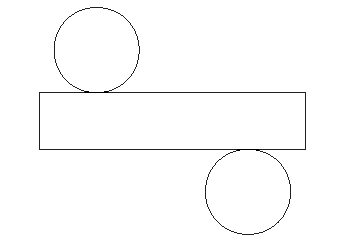
This is a cylinder.  It's net looks like: 
2. Write the formula

Same general formula:              S.A. = P * h + 2 * B
Different specific formula:         S.A. = (2 * pi * r) * h + 2 * (pi * r^2)

Since we're dealing with circles, we use circumference for perimeter and area of a circle for our base.

3. Plug in the numbers
diameter not radius was given   S.A. = (2 * 3.14 * 10) * 5 + 2 * (3.14 * 10^2)
10^2 = 100                             S.A. =  (62.8) * 5 + 2 * (314)
                                               S.A. = 314 + 628
                                               S.A. = 942 square inches.

Last example for now:
1. What shape is it?

This is a rectangular prism.  Never mind the slant, it's still a rectangular prism.
Pick bases:  I'm picking the 3 x 5 sides, as they'll be easy to use.

2. Write formulas:

Same general formula:              S.A. = P * h + 2 * B
Specific formula:                      S.A. = (b+b+h+h) * h + 2 * (b * h)

Again, note that the h outside parenthesis refers to the height of the prism.

3. Plug in the numbers
                                              S.A. = (3+3+5+5) * 12 + 2 * (3 * 5)

4. Solve
                                              S.A. = (16) * 12 + 2 * (15)
                                              S.A. = 192 + 30
                                              S.A. = 222 square inches

3D Nets

We'll work on 3D Nets on Tuesday.  Here are some examples:


The only word that's strange is cuboid, which we call a rectangular prism.  I will go over each of these in detail.

For more interactivity, click here.


This shape has 5 faces, 1 base which is square and 4 triangle sides.


This shape is a triangular prism.  Note that it also has 5 faces, however 3 are rectangles and 2 are triangles.  As with every prism, there are 2 bases.  The faces that are bases are the triangles.

This shape is a triangular pyramid.  The quadrilateral shapes on the edges are not included in the pyramid, those are tabs in case you printed out the shape and attempted to glue it together.  You notice that it has 4 faces, all of which are triangles.  If they're all equivalent, any of those triangles could be the base.


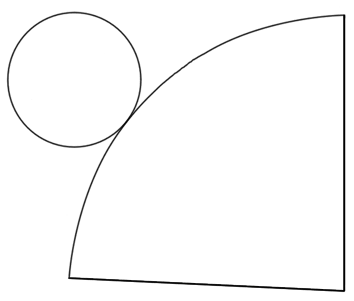
This shape is the net of a cone.  The quarter circle is exactly that, a quarter circle with the height of the cone as the radius.

This is the net of a cylinder.  The long rectangle has a base equal to the circumference of the circle, and the height is equal to the height of the cylinder.


Finally, a net of a rectangular prism.  As you can see, there are 6 faces, just like a cube.  The bases are any two equal and opposite rectangles.  The easiest ones to identify are the ones on the left and right sides.


Source 1
Source 2
Source 3

Pyramids and Cones

The formula for Pyramids and Cones is almost exactly like the formula for Prisms and Cylinders.  One of the major differences is the 1/3.  It's an important difference because in coming to a point for the height, it limits the volume compared to a similar prism or cylinder.  Here are some examples.

The same four steps apply to these shapes.

1. What shape is it?  

It's a cone.  The base is a circle, so we'll need area for that.

2. Write the formulas.

The general formula for cones and pyramids is V=(1/3)B*h

                                                                     V = (1/3) * B * h
specific to cones                                            V = (1/3) * (pi * r^2) * h

3. Plug the numbers in:

The base lists a diameter 2, not a radius, so that radius is 1 (2/2=1).  Height is 3.

                                                                    V = (1/3) * (3.14 * 1^2) * 3
4. Solve

3 divided by 3 is 1.  1^2 is 1.                        V = 1 * 3.14 * 1
                                                                    V = 3.14 cubic feet.

Let's try one that's more difficult.

1. What shape is it?

Cone, same as the first.

2. Write the formulas.

                                                                  V = (1/3) * B * h
Same as the first.                                        V = (1/3) * (pi * r^2) * h

3. Plug the numbers in.

Again the base is a diameter (16), so radius is 8.  V = (1/3) * (3.14 * 8^2) * 16

4. Solve

8^2 = 64.  64 * 3.14 = 200.96                 V = (1/3) * (200.96) * 16
                                                                 V = (1/3) * 3215.36
                                                                 V = 1071.79 cubic meters


Let's try this one.

1. What shape is it?

Pyramid with a square base.  I know it's square because of the 7x7.  The height is defined by the line in the middle.  It could also be listed outside the diagram as a separate line.  In this case, it's 6.

2. Write the formulas

general formula                                     V = (1/3) * B * h
specific formula                                    V = (1/3) * (b * h) * h

3. Plug the numbers in

                                                            V = (1/3) * (7 * 7) * 6

4. Solve
                                                            V = (1/3) * (49) * 6
6 divided by 3 is 2.                               V = 49 * 2
                                                            V = 98 cubic meters.


1. What shape is it?

Another square (rectangular) pyramid.

2. Write the formulas.

general formula                                    V = (1/3) * B * h
specific formula                                   V = (1/3) * (b * h) * h

3. Plug the numbers in
                                                           V = (1/3) * (6 * 6) * 8
4. Solve
                                                           V = (1/3) * (36) * 8
                                                           V = 12 * 8
                                                           V = 96 cubic yards


1. What shape is it?

This one's a triangular pyramid.  There are no rectangles or squares on the shape.  The base has a right triangle, so its base and height are 4 and 3.  The height of the pyramid is the line through the middle, and is 4.

2. Write the formulas

general formula                                   V = (1/3) * B * h
specific formula                                  V = (1/3) *(0.5 * b * h) * h

3. Plug the numbers in
                                                          V = (1/3) * (0.5 * 3 * 4) * 4
4. Solve
                                                          V = (1/3) * (6) * 4
                                                          V = 2 * 4
                                                          V = 8 cubic meters

Thursday, September 5, 2013

Volume: Cylinders and Prisms Examples

More examples as follows:


1. What shape is it?

This is a box, so it's a rectangular prism.  On rectangular prisms, I need to pick 2 opposite sides as my bases.  I am going to choose the top of the shape, and the bottom of the shape.  This means that my base is square because the dimensions are 6x6.

2.  Write the formulas

general                                                         V=Bh
specific to rectangular prisms                        V=(b * h) * h

3. Plug the numbers in:

I get the 6x6 from my base, then the only different number is 3.  If it was a cube, the numbers would all be 6.

                                                                  V=(6 * 6) * 3

4. Solve

Pretty clear here:

36*3 = 108

108 mi^3


1. What shape is it?

This is a ramp, so it's a triangular prism.

2. Write the formulas

general                                                        V=Bh
specific to triangular prisms                          V=(0.5 * b * h) * h

3. Plug the numbers in:

The two bases are triangles, so I need to be looking for that right angle.  It's in the bottom corner, so my dimensions for my triangle are 8*6.  It looks like the dimensions for each rectangle are 10*8, 6*8, and 8*8, so that means my height is 8.

                                                                  V=(0.5 * 8 * 6) * 8

8 * 6= 48
48 * 0.5 = 24
24 * 8 = 192

192 in^3


1. What shape is it?

This is a can, so it's a cylinder.

2. Write formulas

general                                                  V=Bh
specific to cylinders                               V=(pi * r^2) * h

3. Plug the numbers in:

20 cm is for the whole way across the circular base.  That means I need half that for radius, so 10.  The only other number on here is 9.

                                                           V=(3.14 * 10^2) * 9
10^2 = 100.
100 * 3.14 = 314

13
314
*  9
____
2826

2826 cm^3

We'll do pyramids and cones later.