I'm sure some of you have wondered "how does Mr. V. know all these tricks?" One reason is because I have learned this set of arithmetic properties here:
http://www.coolmath.com/prealgebra/06-properties/
Many of you are already using these without knowing it. The multiplicative inverse property is used in solving proportions through butterfly method.
The additive inverse property is used to solve for x in linear relationships when y is constant.
I just like the way the concepts are presented at coolmath. I hope you do too.
Oh, and if you don't learn them now, you will continue to struggle and will probably have trouble in the rest of your math career through high school and possibly beyond.
Showing posts with label examples. Show all posts
Showing posts with label examples. Show all posts
Tuesday, November 12, 2013

Monday, September 9, 2013
Surface Area: Pyramids
Now that we've looked at prisms and cylinders, we need to consider the formula for pyramids.

2. Write the formulas
As you can see on the formula chart, this formula is rather different compared to prisms and cylinders. One of the differences is the requirement of lateral height (l). This is the height from the base to the top of the pyramid measured along a face instead of through the middle of the shape. Since the sides are all triangles, they would add up into one big triangle, but would still follow the area formula, so that's where the 1/2 comes from. Also there is only one base.
General S. A. = (1/2) * P * l + B
Specific S. A. = (1/2) * (s+s+s) * l + ((1/2) * b * h)
3. Plug in the numbers
S. A. = (1/2) * (5 + 5 + 5) * 7.1 + ((1/2) * 5 * 4.3)
4. Solve
That looks like alot, so let's break it down by using order of operations. The perimeter is easy with 15, and half that is 7.5.
S. A. = 7.5 * 7.1 + ((1/2) * 5 * 4.3)
Next, half of 5 is 2.5. S. A. = 7.5 * 7.1 + (5 * 4.3)
S. A. = 53.25 + 21.5
S. A. = 74.75 square feet
Let's try another.
 1. What shape is it?
This is a rectangular or square pyramid.
2. Write the formulas
General S. A. = (1/2) * P * l + B
Specific S. A. = (1/2) * (2b + 2h) * l + (b * h)
3. Plug in the numbers
S. A. = (1/2) * (2 * 9 + 2 * 9) * 9.2 + (9 * 9)
4. Solve
S. A. = (18) * 9.2 + (81)
S. A. = 165.6 + 81
S. A. = 246.6 square centimeters
1. What shape is it?
There are no rectangular faces, so this is a triangular pyramid.
As you can see on the formula chart, this formula is rather different compared to prisms and cylinders. One of the differences is the requirement of lateral height (l). This is the height from the base to the top of the pyramid measured along a face instead of through the middle of the shape. Since the sides are all triangles, they would add up into one big triangle, but would still follow the area formula, so that's where the 1/2 comes from. Also there is only one base.
General S. A. = (1/2) * P * l + B
Specific S. A. = (1/2) * (s+s+s) * l + ((1/2) * b * h)
3. Plug in the numbers
S. A. = (1/2) * (5 + 5 + 5) * 7.1 + ((1/2) * 5 * 4.3)
4. Solve
That looks like alot, so let's break it down by using order of operations. The perimeter is easy with 15, and half that is 7.5.
S. A. = 7.5 * 7.1 + ((1/2) * 5 * 4.3)
Next, half of 5 is 2.5. S. A. = 7.5 * 7.1 + (5 * 4.3)
S. A. = 53.25 + 21.5
S. A. = 74.75 square feet
Let's try another.
This is a rectangular or square pyramid.
2. Write the formulas
General S. A. = (1/2) * P * l + B
Specific S. A. = (1/2) * (2b + 2h) * l + (b * h)
3. Plug in the numbers
S. A. = (1/2) * (2 * 9 + 2 * 9) * 9.2 + (9 * 9)
4. Solve
S. A. = (18) * 9.2 + (81)
S. A. = 165.6 + 81
S. A. = 246.6 square centimeters
Sunday, September 8, 2013
Surface Area
So, now let's talk about surface area. It's exactly that, the area of the surface of a 3D shape. So if you understand how the 3D Net works of that shape, the surface area makes sense.
The general formula for surface area for prisms is as follows:
The perimeter of the base times the height, plus the area of the base times two. So, let's look at a few examples for more information.


3. Plug in the numbers
diameter not radius was given S.A. = (2 * 3.14 * 10) * 5 + 2 * (3.14 * 10^2)
10^2 = 100 S.A. = (62.8) * 5 + 2 * (314)
S.A. = 314 + 628
S.A. = 942 square inches.
Last example for now:

The general formula for surface area for prisms is as follows:
The perimeter of the base times the height, plus the area of the base times two. So, let's look at a few examples for more information.
Here is a triangular prism. It's 3D net is similar to this:

The large rectangle in the middle has a base equal to the height of the shape, and a height equal to the perimeter of the base.
So let's follow the same steps we use for Volume and work this out.
1. What shape is it? Already identified.
2. Write our formula.
General S.A. = P * h + 2 * B
Specific S.A. = (s+s+s) * h + 2 * (0.5 * b * h)
Remember that the height in the general formula refers to the height of the prism. Also remember to follow order of operations. The area of the base is still the area of a triangle formula, just like with volume.
3. Plug in the numbers
S.A. = (9+8+7) * 5 + 2 (0.5 * 9 * 6)
That looks like a lot, but with practice, it will get easier.
4. Solve
S.A. = (24) * 5 + 2 (27)
S.A. = 120 + 54
S.A. = 174 square miles
Since it's area, it won't be cubic miles. We're measuring the covering on the outside of the shape, not how much space is contained inside it. Let's try another.
1. What shape is it?
This is a cylinder. It's net looks like:
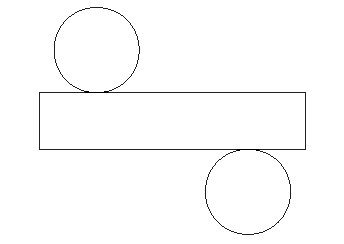
2. Write the formula
Same general formula: S.A. = P * h + 2 * B
Different specific formula: S.A. = (2 * pi * r) * h + 2 * (pi * r^2)
Since we're dealing with circles, we use circumference for perimeter and area of a circle for our base.
diameter not radius was given S.A. = (2 * 3.14 * 10) * 5 + 2 * (3.14 * 10^2)
10^2 = 100 S.A. = (62.8) * 5 + 2 * (314)
S.A. = 314 + 628
S.A. = 942 square inches.
Last example for now:
1. What shape is it?
This is a rectangular prism. Never mind the slant, it's still a rectangular prism.
Pick bases: I'm picking the 3 x 5 sides, as they'll be easy to use.
2. Write formulas:
Same general formula: S.A. = P * h + 2 * B
Specific formula: S.A. = (b+b+h+h) * h + 2 * (b * h)
Again, note that the h outside parenthesis refers to the height of the prism.
3. Plug in the numbers
S.A. = (3+3+5+5) * 12 + 2 * (3 * 5)
4. Solve
S.A. = (16) * 12 + 2 * (15)
S.A. = 192 + 30
S.A. = 222 square inches
3D Nets
We'll work on 3D Nets on Tuesday. Here are some examples:

The only word that's strange is cuboid, which we call a rectangular prism. I will go over each of these in detail.
For more interactivity, click here.

This shape has 5 faces, 1 base which is square and 4 triangle sides.
This shape is a triangular prism. Note that it also has 5 faces, however 3 are rectangles and 2 are triangles. As with every prism, there are 2 bases. The faces that are bases are the triangles.
 This shape is a triangular pyramid. The quadrilateral shapes on the edges are not included in the pyramid, those are tabs in case you printed out the shape and attempted to glue it together. You notice that it has 4 faces, all of which are triangles. If they're all equivalent, any of those triangles could be the base.

This shape is the net of a cone. The quarter circle is exactly that, a quarter circle with the height of the cone as the radius.
This is the net of a cylinder. The long rectangle has a base equal to the circumference of the circle, and the height is equal to the height of the cylinder.

Finally, a net of a rectangular prism. As you can see, there are 6 faces, just like a cube. The bases are any two equal and opposite rectangles. The easiest ones to identify are the ones on the left and right sides.
Source 1
Source 2
Source 3
The only word that's strange is cuboid, which we call a rectangular prism. I will go over each of these in detail.
For more interactivity, click here.

This shape has 5 faces, 1 base which is square and 4 triangle sides.
This shape is a triangular prism. Note that it also has 5 faces, however 3 are rectangles and 2 are triangles. As with every prism, there are 2 bases. The faces that are bases are the triangles.
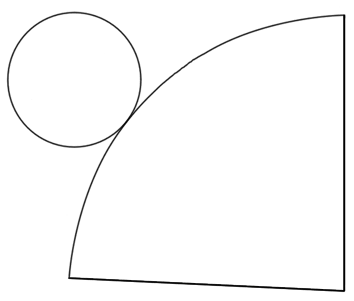
This shape is the net of a cone. The quarter circle is exactly that, a quarter circle with the height of the cone as the radius.

Finally, a net of a rectangular prism. As you can see, there are 6 faces, just like a cube. The bases are any two equal and opposite rectangles. The easiest ones to identify are the ones on the left and right sides.
Source 1
Source 2
Source 3
Pyramids and Cones
The formula for Pyramids and Cones is almost exactly like the formula for Prisms and Cylinders. One of the major differences is the 1/3. It's an important difference because in coming to a point for the height, it limits the volume compared to a similar prism or cylinder. Here are some examples.


Again the base is a diameter (16), so radius is 8. V = (1/3) * (3.14 * 8^2) * 16
4. Solve
8^2 = 64. 64 * 3.14 = 200.96 V = (1/3) * (200.96) * 16
V = (1/3) * 3215.36
V = 1071.79 cubic meters


The same four steps apply to these shapes.
1. What shape is it?
It's a cone. The base is a circle, so we'll need area for that.
2. Write the formulas.
The general formula for cones and pyramids is V=(1/3)B*h
V = (1/3) * B * h
specific to cones V = (1/3) * (pi * r^2) * h
3. Plug the numbers in:
The base lists a diameter 2, not a radius, so that radius is 1 (2/2=1). Height is 3.
V = (1/3) * (3.14 * 1^2) * 3
4. Solve
3 divided by 3 is 1. 1^2 is 1. V = 1 * 3.14 * 1
V = 3.14 cubic feet.
Let's try one that's more difficult.
1. What shape is it?
Cone, same as the first.
2. Write the formulas.
V = (1/3) * B * h
Same as the first. V = (1/3) * (pi * r^2) * h
3. Plug the numbers in.
Again the base is a diameter (16), so radius is 8. V = (1/3) * (3.14 * 8^2) * 16
4. Solve
8^2 = 64. 64 * 3.14 = 200.96 V = (1/3) * (200.96) * 16
V = (1/3) * 3215.36
V = 1071.79 cubic meters
Let's try this one.
1. What shape is it?
Pyramid with a square base. I know it's square because of the 7x7. The height is defined by the line in the middle. It could also be listed outside the diagram as a separate line. In this case, it's 6.
2. Write the formulas
general formula V = (1/3) * B * h
specific formula V = (1/3) * (b * h) * h
3. Plug the numbers in
V = (1/3) * (7 * 7) * 6
4. Solve
V = (1/3) * (49) * 6
6 divided by 3 is 2. V = 49 * 2
V = 98 cubic meters.
1. What shape is it?
Another square (rectangular) pyramid.
2. Write the formulas.
general formula V = (1/3) * B * h
specific formula V = (1/3) * (b * h) * h
3. Plug the numbers in
V = (1/3) * (6 * 6) * 8
4. Solve
V = (1/3) * (36) * 8
V = 12 * 8
V = 96 cubic yards
1. What shape is it?
This one's a triangular pyramid. There are no rectangles or squares on the shape. The base has a right triangle, so its base and height are 4 and 3. The height of the pyramid is the line through the middle, and is 4.
2. Write the formulas
general formula V = (1/3) * B * h
specific formula V = (1/3) *(0.5 * b * h) * h
3. Plug the numbers in
V = (1/3) * (0.5 * 3 * 4) * 4
4. Solve
V = (1/3) * (6) * 4
V = 2 * 4
V = 8 cubic meters
Subscribe to:
Posts (Atom)