Showing posts with label geometry. Show all posts

Sunday, January 26, 2014

Rotation


First, identify what counterclockwise means.  The way to remember is that counter means against.

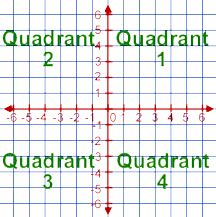
Next, identify the points.  U is at (2,-2), A is at (3, -2), G is at (1, -5), then N is at (2, -5). The next part is a bit tricky and uses your knowledge about the quadrants.  So to go 90 degrees, I need to switch X and Y. and then because I went from Quadrant IV to Quadrant I, I turn all the negatives into positives. To go 180 degrees, I need to go from Quadrant IV to Quadrant II, so I need to switch their signs.  To go 270 degrees, I need to switch their signs and then switch X and Y.

In this case, I only want to go 90 degrees, so lets switch X and Y and turn them all positive.  U becomes U' (2,2).  A becomes A' (2, 3).  N becomes N' (5, 2).  Finally G becomes G' at (5, 1)


All that's left is to draw in the lines.

Friday, January 24, 2014

Translations

First identify the points of the shape.  2 of them are in quadrant 1 and 1 is in quadrant 4.  So D is at 1 left and 3 up.  So D (1, 3) is the top of the triangle.  Then U is 4 left 0 up, so U (4, 0).  Then C is 0 left and 2 down: C (0, -2).
Next, subtract 5 from the x and add 2 to the y.  So D' (1 - 5, 3 + 2)  or (-4, 5).  U' would be (4 - 5, 0 + 2) or (-1, 2).  C' would be (0 -5, -2 + 2) or (-5, 0).


Once the new points are plotted, draw the lines in of the shape.

Geometry Basics

Coordinate Plane

Two number lines set at 90 degrees from each other create a coordinate plane.


http://www.math.com/school/subject2/images/S2U4L1DP.gif


x-axis

The x-axis is the number line going left to right.  Positive numbers are on the right, and negative numbers are on the left.

y-axis

The y-axis is the number line going up and down.  Positive numbers are on the top, and negative numbers are on the bottom.

point

A point is a specific spot on the graph.

origin

The point where the x-axis and y-axis intersect.  It's ordered pair is (0,0).

ordered pair

The distance from the origin showing first to the left or right (x) then up or down (y).  The point (4,2) is right 4, up 2.


Line

A line is when two or more points are in a row.  Most people can draw a line based on two points, but in order to find other points on the line without using the graph, you need to understand the formula, which is y = mx + b.  Y is the dependent variable, X is the independent variable.  This means that all the X will have one and only one Y.  The other two letters help define the line.  b is called the y-intercept and shifts the graph up or down by that number.  m is called the slope and defines how fast the graph goes up.

Slope

To find the slope, you get two points.  Then you find the difference between the first and second in height, then the difference between the first and second in distance left or right from 0.


On this graph here, you can identify the following points: (-2, 1 ) (-1, 2) (0, 3) (1, 4) (2, 5)

To find the slope identify the distance between Y, then divide it by the distance between X.  So for (-2, 1) to (-1, 2), the distance between 1 and 2 is 1.  Then we divide it by the distance between -2 and -1 and we get 1.  1 divided by 1 is 1, so m = 1.  Then we identify where the line is when X is zero.  (0, 3).  So b = 3.  The line is y = 1x + 3.

Thursday, January 16, 2014

Reflections

Here's how to do reflections, step by step.

Here's the problem.


First: Identify the Line you must reflect across.  In this case it's the y-axis, which is the line when all x are zero.

 Next, locate the points on the shape.  Point F is at (3, 5); V (3, 2) and X (5, 2).  Knowing this, you can use the distance from the y-axis to define the next points.  Each point must be the same distance from the line of reflection as its prime (').

So, F' is at (-3, 5); V (-3, 2) and X at (-5,2)  Notice how each point is the same distance away from the y-axis.  F' is 3 away, and F is 3 away too.


Finally draw in your lines.

Misconceptions:

1.  A reflection does not change any of the shapes angles or the lengths of any segments forming the shape.

2.  A reflection is based on a line, not a point.  The line can have any value, not just on the x-axis or y-axis.  Finding the line of reflection is based on how far the points are from each other, then plotting points halfway between until a line is formed.  This means the distance from the two shapes divided by 2.

3.  The shape should not "turn".  It is reflected, not translated and then rotated.