Video Link
Showing posts with label math in the real world. Show all posts
Showing posts with label math in the real world. Show all posts
Saturday, October 11, 2014

Sunday, February 9, 2014
Tuesday, November 12, 2013
Scientific Notation Flow Chart

Wednesday, October 23, 2013
Tuesday, October 15, 2013
Thursday, September 5, 2013
Tuesday, September 3, 2013
Caine's Arcade: Shoebox Version
For our first project of the year, we will be creating shoebox versions of arcade games. Our goal for this project is to create scale models of the arcade games so that we have prototypes (first versions) that are easily tested and shared. Also a shoebox is more portable than the constructs we will be making for the Global Day of Play.
Thus, everyone should watch at least the first video of Caine's Arcade in order to know what we're talking about. When you're done, come back here for the list of things needed.
Original Arcade Game Dimensions: You need to specify a height, a width, and a length. They need to be in inches, so you need to convert yards and feet to inches. If the game has different geometry in places, divide the game into simpler geometry. So if I was miniaturizing a skee-ball game, I would have the track as one shape, and then the scoring area as another.

Once I have the basic shapes, I would need to do some research (asking google is a good place to start) about the dimensions of the game. If you use the word "dimensions" you should get clearer options.
Once you've done that, you also need Original Shoebox Dimensions, again in inches. This will give you an idea of if your dimensions match, or if you need to make the shoebox arcade game dimensions smaller than the shoebox. Trying to make your shoebox fit the arcade is a bad idea and will probably lead to a lot of extra work. That said, I won't penalize anyone who does this, provided their scale factor is correct.
Finally, you need to prove that all your dimensions have the same scale factor. If you don't know what that math term is, don't worry, I'll be explaining it before you have to turn this project in.
So to list it out, the things I'm expecting are:
Shoebox Arcade Game
A piece of paper with the following written on it:
Your heading, Shoebox Arcade Game as the title,
Name of Arcade Game picked,
Original Dimensions of the Arcade Game you picked,
Original Dimensions of the Shoebox,
Dimensions of the Game that fit on/in the shoebox,
Scale factor between the original and small game,
Additional materials used listed.
If you want to create a totally new game, see me and we'll discuss similar arcade games to use as dimensions.
Thus, everyone should watch at least the first video of Caine's Arcade in order to know what we're talking about. When you're done, come back here for the list of things needed.
Original Arcade Game Dimensions: You need to specify a height, a width, and a length. They need to be in inches, so you need to convert yards and feet to inches. If the game has different geometry in places, divide the game into simpler geometry. So if I was miniaturizing a skee-ball game, I would have the track as one shape, and then the scoring area as another.

Once I have the basic shapes, I would need to do some research (asking google is a good place to start) about the dimensions of the game. If you use the word "dimensions" you should get clearer options.
Once you've done that, you also need Original Shoebox Dimensions, again in inches. This will give you an idea of if your dimensions match, or if you need to make the shoebox arcade game dimensions smaller than the shoebox. Trying to make your shoebox fit the arcade is a bad idea and will probably lead to a lot of extra work. That said, I won't penalize anyone who does this, provided their scale factor is correct.
Finally, you need to prove that all your dimensions have the same scale factor. If you don't know what that math term is, don't worry, I'll be explaining it before you have to turn this project in.
So to list it out, the things I'm expecting are:
Shoebox Arcade Game
A piece of paper with the following written on it:
Your heading, Shoebox Arcade Game as the title,
Name of Arcade Game picked,
Original Dimensions of the Arcade Game you picked,
Original Dimensions of the Shoebox,
Dimensions of the Game that fit on/in the shoebox,
Scale factor between the original and small game,
Additional materials used listed.
If you want to create a totally new game, see me and we'll discuss similar arcade games to use as dimensions.
Tuesday, August 27, 2013
Planning
Image Source
If you don't understand the problem, creating a solution can be nearly impossible.

Word problems can be especially tricky, especially when they don't have accurate diagrams attached.

If you see a word problem that has to do with 2D or 3D shapes, one of the first things you should do is to draw a diagram using the information given. That's why it's important to pay attention when Mr. V explains how to draw the shapes, especially 3D ones. That's coming up in a video for next week. Also watch out when a word problem starts slinging around a variable, as they might not always want to know what the variable stands for. All of this has to do with understanding the problem.
Once you've done that, you can make a plan of what to do about it. Perhaps your plan might include drawing the shape being described, or if the shape is on it's side, redrawing it so that it is on the base. Or finding what the variable stands for so that you can test each answer choice.
Then you need to be extra careful about working your plan. If your drawing is missing some information, you might need to adjust it. Or if you aren't careful in finding the variable, your tests might say all answer choices were wrong.
In those cases, the reasonableness (meaning is it likely that the answer you got is the correct one) comes into question. So you may need to look at the answer choices to see if you're close or way off. Again, be careful about this, as there may be one close to yours intentionally placed there by the test giver.
At any rate, knowing what plans to use is a skill that can be practiced, and I intend for us to do that.
So, now that you've read the post, either put in your journal or take a sheet of paper and let me know where you think you might run into trouble when trying to solve word problems.
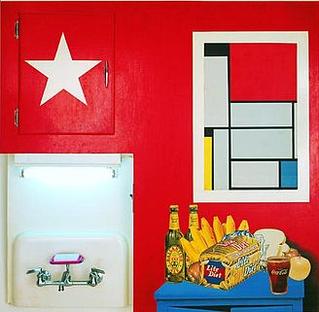
Cubism vs Pop Art
These two forms of art have much more geometric qualities, one due to style, the other due to substance. Let's create a Venn diagram to compare the two movements.
Cubism Pop Art

 Violin and Candle by Georges Braque on left and Still Life 20 by Tom Wesselmann on right.
Cubism Pop Art

Saturday, August 17, 2013
This Game is Amazing!
Kerbal Space Program 101
Many of the concepts needed for rocketry require Calculus and Trigonometry, which both require a basic understanding of mathematics concepts in order to be clear. A strong understanding of ratios is also very important.
Monday, August 12, 2013
Quickly Solve Any Percent!
Understanding percents mostly require your multiplication facts.
Percentage Trick
Pretty nice, huh? Here are a few more examples.
Percentage Trick 2
Hope this helps you when you look at percentages. Especially when you're shopping or trying to figure out how much tax or tip is!
Pretty nice, huh? Here are a few more examples.
Hope this helps you when you look at percentages. Especially when you're shopping or trying to figure out how much tax or tip is!
The Future Is Closer Than You Think
Science fiction is quickly becoming science reality. Here's an example.
Mind Over Mechanics
Think this doesn't involve math? You forget that anything involving a computer involves mathematics.
Think this doesn't involve math? You forget that anything involving a computer involves mathematics.
Friday, July 26, 2013
Cubism

In Two Figures (1913-14), Liubov' Popova beautifully demonstrates the artistic possibilities of a Cubist reconstruction and, at the same time, her talent to transcend simple imitation. http://myweb.rollins.edu/aboguslawski/Ruspaint/cubism.html
Sometimes students are incapable of seeing the art in mathematics. Thus, I intend to display the mathematics in art. There are two-dimensional and three-dimensional shapes in this painting. Finding out how many and their dimensions might be a challenging group project.
Advanced Mathematics: Uses of Calculus
Another answer to the "When are we going to use math?" question. Calculus provides mathematics answers to questions sometimes we didn't even know we were asking. http://www.dummies.com/how-to/education-languages/math/Calculus/Practical-Applications.html has a whole list of problems that are answered with Calculus mathematics.
Sure, anecdotal or observational information could be substituted for the mathematics, but the mathematics will stay constant even when situations change. For instance, calculus finds maximums and minimums very quickly, and thus will define the dimensions of a box based on the total area of a sheet of cardboard, through relating volume to surface area.
In this case, the math is faster and less expensive in time and materials than simply building boxes until you come to the maximum. Thus, in order to understand this application, you must understand calculus and how surface area would confine volume, since both are related to the dimensions of the shape involved (rectangles). So this is one example of how the math we learn in middle school relates to the math learned later in life.
Sure, anecdotal or observational information could be substituted for the mathematics, but the mathematics will stay constant even when situations change. For instance, calculus finds maximums and minimums very quickly, and thus will define the dimensions of a box based on the total area of a sheet of cardboard, through relating volume to surface area.
In this case, the math is faster and less expensive in time and materials than simply building boxes until you come to the maximum. Thus, in order to understand this application, you must understand calculus and how surface area would confine volume, since both are related to the dimensions of the shape involved (rectangles). So this is one example of how the math we learn in middle school relates to the math learned later in life.
Monday, July 22, 2013
Estimation or Using the Test Against Itself
Hello everyone. I'd like to discuss using estimation as a test taking strategy. This is one of my favorites, but one some students that I encountered did not willingly embrace. Some of the complaints were that it was extra work, or that they were not careful enough with the estimation. I believe they may have had bad experiences in the past with estimation and rounding, as it has a few arbitrary rules that they may have been caught up in.
Estimation is a vital skill that we use every day whether we know it or not. When we're out shopping, we estimate prices all the time. 19.95 becomes 20 very quickly. This in turn, helps us calculate and budget how much should be spent on each item. It also helps us compare prices, especially when the stores don't want to give out cost per unit. 3.99 for 10 apples for example versus 0.67 for 1 apple.
Where students seem to be falling down is that they don't understand when to estimate, or what information the estimate gives us, thus why it's useful. Estimation is especially useful on problems that involve measurement, as they nearly all include multiplication, sometimes multiple step multiplication. Thus, having an easier set of multiplication to do can eliminate answers, perhaps even enough answers that the correct one is left alone.
Estimation gives us minimums and maximums. In my example above, the maximum it will be is $20. Then estimating tax of 10% gives us tax of $2, so we should have $22 ready to spend at the register for our item that costs $21.64 exactly. Thus, we got a maximum price, exceeded it so that we would get change back instead of having to leave without the item.
Likewise with measurement. We should estimate close to the measurements given but make sure we always round down to get our minimum, then always round up to get our maximum. This strategy can help students who are not careful with decimals when they multiply. Students who know their multiplication facts will also find that estimation is much faster than multiplying the decimals out. Other things to point out would be when a number is very close to an easy multiplication fact, like 2, 5, or 10.
The problem with this strategy, when the test is really mean, is that it is possible that it will not eliminate enough answers and a guess or the long multiplication is still required. In that case, remind students that their exact answer will fall between their minimums and maximums. Looking at the entire question including the answers would be the best idea to determine if they should estimate or not. If the numbers vary greater than 3-4, estimation will eliminate 1-2 answer choices and possibly all 3 of the wrong ones.
Estimation is a vital skill that we use every day whether we know it or not. When we're out shopping, we estimate prices all the time. 19.95 becomes 20 very quickly. This in turn, helps us calculate and budget how much should be spent on each item. It also helps us compare prices, especially when the stores don't want to give out cost per unit. 3.99 for 10 apples for example versus 0.67 for 1 apple.
Where students seem to be falling down is that they don't understand when to estimate, or what information the estimate gives us, thus why it's useful. Estimation is especially useful on problems that involve measurement, as they nearly all include multiplication, sometimes multiple step multiplication. Thus, having an easier set of multiplication to do can eliminate answers, perhaps even enough answers that the correct one is left alone.
Estimation gives us minimums and maximums. In my example above, the maximum it will be is $20. Then estimating tax of 10% gives us tax of $2, so we should have $22 ready to spend at the register for our item that costs $21.64 exactly. Thus, we got a maximum price, exceeded it so that we would get change back instead of having to leave without the item.
Likewise with measurement. We should estimate close to the measurements given but make sure we always round down to get our minimum, then always round up to get our maximum. This strategy can help students who are not careful with decimals when they multiply. Students who know their multiplication facts will also find that estimation is much faster than multiplying the decimals out. Other things to point out would be when a number is very close to an easy multiplication fact, like 2, 5, or 10.
The problem with this strategy, when the test is really mean, is that it is possible that it will not eliminate enough answers and a guess or the long multiplication is still required. In that case, remind students that their exact answer will fall between their minimums and maximums. Looking at the entire question including the answers would be the best idea to determine if they should estimate or not. If the numbers vary greater than 3-4, estimation will eliminate 1-2 answer choices and possibly all 3 of the wrong ones.
Sunday, July 21, 2013
Future Mathematics: Fractals
One thing my students tend to ask me, is "Mr. V? Where is math in our lives?" Sometimes that answer has clear ties to what we're learning in class, but other times the mathematics are more advanced. Fractals are a great example of advanced mathematics with current application. Some examples follow:
Urban Planning:
http://www.nature.com/srep/2012/120724/srep00527/full/srep00527.html
Natural Patterns:
http://webecoist.momtastic.com/2008/09/07/17-amazing-examples-of-fractals-in-nature/
Chemistry/Physics:
http://www.wired.com/wiredscience/2010/08/superconductor-fractals/
Art
http://www.oneness4all.com/?cat=44
Crop Circles
http://www.cropcircleconnector.com/Bert/3dfractals.html
3D Graphics
http://www.profantasy.com/products/ft.asp
http://specialeffectsmoviesebook.blogspot.com/2013/02/1-fractals-in-special-effects.html
Technology
http://classes.yale.edu/fractals/panorama/ManuFractals/FractalAntennas/FractalAntennas.html
Sound and Music
http://www.tursiops.cc/fm/
Urban Planning:
http://www.nature.com/srep/2012/120724/srep00527/full/srep00527.html
Natural Patterns:
http://webecoist.momtastic.com/2008/09/07/17-amazing-examples-of-fractals-in-nature/
Chemistry/Physics:
http://www.wired.com/wiredscience/2010/08/superconductor-fractals/
Art
http://www.oneness4all.com/?cat=44
Crop Circles
http://www.cropcircleconnector.com/Bert/3dfractals.html
3D Graphics
http://www.profantasy.com/products/ft.asp
http://specialeffectsmoviesebook.blogspot.com/2013/02/1-fractals-in-special-effects.html
Technology
http://classes.yale.edu/fractals/panorama/ManuFractals/FractalAntennas/FractalAntennas.html
Sound and Music
http://www.tursiops.cc/fm/
Subscribe to:
Posts (Atom)